 Deutsch (Deutschland)
  English (United Kingdom)
 Promoting Scientific Thinking Through Practice and Educational Support
From 8 to 12 June 2026, Kasese Municipal High Humanist School in Uganda held its second Science Week this year.
The five-day program combined practical experiments, targeted academic support, and real-world learning experiences. Its aim was to strengthen students’ scientific understanding, foster critical thinking, and improve preparation for national examinations. The event was widely attended by students and staff and has been described by the school as one of the most impactful academic activities of the year.
Hands-on Science and Real-World Learning
A central element of the program was the strong emphasis on practical learning. Students conducted experiments in chemistry, biology, physics, and agriculture, applying theoretical knowledge in a structured and supervised environment.
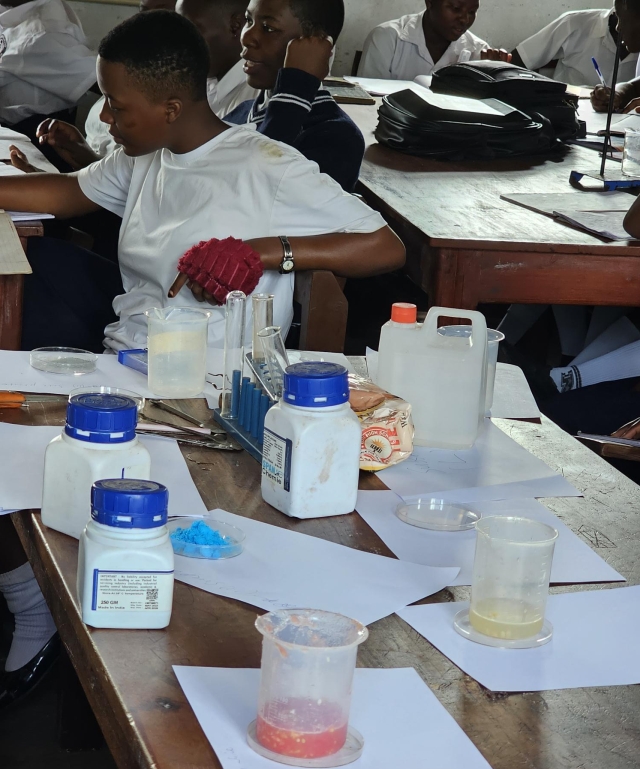
In addition, an outdoor field study along the Nyamwamba River enabled students to observe environmental and scientific phenomena directly. Guided by teachers, participants were encouraged to ask questions and connect classroom concepts with real-world contexts, making the learning experience both interactive and memorable.
Focus on Examination Skills
An important component of Science Week was support for examination preparation. Two experienced national examiners provided dedicated tutorial sessions, explaining how examinations are assessed and how marks are awarded.
Students received practical advice on answering techniques, time management, and strategies for maximising performance in science subjects. This direct insight into examination processes is particularly valuable in helping students translate their knowledge into measurable academic success.
A Supportive Learning Environment
To ensure that students could fully engage in the intensive program, the school provided daily refreshments, and the week concluded with a shared meal for the entire school community.
Such measures contribute to a positive and inclusive learning environment, reinforcing motivation and creating a sense of shared achievement among students, teachers, and facilitators.
Scientific Temper Perspective
Scientific Temper supports educational initiatives that strengthen scientific literacy, critical thinking, and evidence-based reasoning. Science Week at Kasese Municipal High Humanist School is a concrete example of how targeted support can create meaningful educational impact.
Three aspects are particularly relevant from our perspective:
- First, the integration of theory and practice. Hands-on experiments and field studies allow students to experience science as a method for understanding the world, rather than as a purely abstract subject.
- Second, the focus on critical thinking and examination literacy. Understanding how knowledge is evaluated helps students move beyond rote learning and develop structured reasoning skills.
- Third, the importance of motivation and community. Providing a supportive environment, including shared activities and recognition of effort, strengthens students’ engagement with learning.
The feedback from the school indicates that students gained not only knowledge and practical skills but also renewed confidence and motivation. This aligns with Scientific Temper’s broader goal of empowering young people to approach the world with curiosity, rational inquiry, and a commitment to evidence-based thinking.
Outlook
Scientific Temper intends to continue and expand its support for science education initiatives of this kind. Another Science Week is already planned for later this year, building on the positive experience and strong results achieved in June.
Beyond Kasese, Scientific Temper is also exploring opportunities to support similar programs in additional schools in Africa and India. The aim is to extend access to high-quality science education, practical learning experiences, and critical thinking tools to a broader group of students.
Science Week 2026 demonstrates that focused interventions can make a measurable difference. Expanding such initiatives has the potential to multiply this impact and strengthen the scientific temper as a foundation for education across different regions.